Wreckage as Raw Material: How Artists Are Turning Their Worst Creative Moments Into Their Best Work
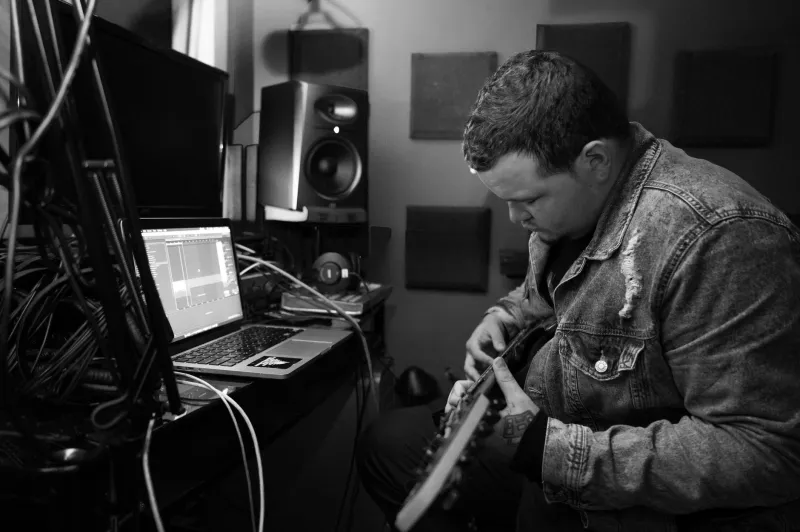
There's a folder on almost every artist's hard drive that never gets opened. You know the one. It's full of half-finished demos, cringe-worthy early recordings, and projects that got one listen from a label contact before disappearing into a polite silence. Most musicians treat that folder like a crime scene — something to avoid, maybe eventually delete.
But a growing number of emerging artists are doing something radically different. They're opening that folder. On purpose. And what they're finding inside is changing the way they make music.
The Autopsy Nobody Wants to Do
Let's be honest: going back to your early failures is uncomfortable. It's like watching footage of yourself learning to walk — awkward, kind of painful, and not exactly flattering. But discomfort, it turns out, is kind of the whole point.
When Nashville-based singer-songwriter Dani Calloway spent a weekend last year listening through three years of rejected demos, she wasn't feeling nostalgic. She was doing what she now calls a "creative autopsy." Her goal wasn't to find hidden gems. It was to figure out exactly what kept going wrong.
"I kept pitching songs that I thought were solid, and they kept getting passed on," she says. "At some point you have to stop blaming the gatekeepers and actually ask yourself what the pattern is."
What she found surprised her. The songs she loved most — the ones she'd been most excited about — were consistently the ones that tried to do too many things at once. Big emotional swings, genre-blending production, lyrics that zigzagged between themes. She'd been mistaking complexity for depth.
"My failures had a signature," she says. "Once I saw it, I couldn't unsee it."
Her last EP, written after that weekend of excavation, stripped everything back. One emotional lane per song. Clean production. It landed her a sync placement within two months of release.
Failure Has a Fingerprint
That idea — that creative failure has a recognizable fingerprint — is something a lot of artists are starting to take seriously. And it makes a certain kind of sense. Success is often messy and hard to replicate. But failure? Failure tends to rhyme.
Producer and multi-instrumentalist Marcus Webb, who operates out of Atlanta, spent the first four years of his career releasing music that got respectful but lukewarm responses. Decent streams, minimal traction, a lot of "this is cool but it's not quite right for us" from blogs and playlist curators.
"I was good enough that people didn't ignore me, but not defined enough that anyone remembered me," he says. "That's almost a harder place to be than just being bad."
When Marcus finally sat down and mapped out every project he'd released or pitched — what the instrumentation was, what the BPM range was, what emotional tone he was going for — he noticed something. His most forgettable work all lived in the middle. Mid-tempo. Mid-energy. Mid-emotion. He'd been so afraid of alienating listeners that he'd made music that was easy to skip.
"I was basically making music for nobody by trying to make music for everybody," he says.
His next project went deliberately extreme in the opposite direction — dense, maximalist, emotionally unhinged in places. It found an audience almost immediately, including a feature in a prominent indie music newsletter and a spot on a Spotify editorial playlist.
The Psychology of Looking Back
There's a reason most artists avoid this kind of retrospective honesty, and it's not just ego. Revisiting failure triggers something real in the brain. Psychologists call it "failure aversion" — the tendency to avoid information that confirms we weren't as good as we thought we were. It's protective, but it's also limiting.
What artists like Dani and Marcus are doing is essentially training themselves out of that reflex. They're treating old failures not as verdicts on their talent, but as data points in an ongoing experiment.
The distinction matters. A verdict is final. Data is just information waiting to be used.
This reframe — from judgment to information — is something music coaches and creative consultants are increasingly building into their work with emerging artists. Instead of asking "why did this fail," the more useful question becomes "what was this trying to do, and what got in the way of it doing that?"
That's a much less threatening question. And it tends to produce much more actionable answers.
What the Demos Are Actually Saying
One thing that comes up repeatedly when artists talk about this process is the gap between intention and execution in early work. A failed demo often isn't failed because the idea was bad. It's failed because the artist didn't yet have the skills, vocabulary, or self-awareness to execute the idea properly.
That's actually an encouraging finding. It means the instincts were often right — they just needed time to catch up with themselves.
For Chicago-based vocalist and producer Lexi Okafor, that realization was the turning point. She'd spent years embarrassed by a batch of demos she'd made at nineteen — overwrought, underproduced, emotionally raw to the point of being hard to listen to. When she finally revisited them in her mid-twenties, she heard something different.
"The ideas were actually interesting," she says. "The execution was a mess, but the instincts were there. I was reaching for something I just didn't know how to grab yet."
She's now in the process of rebuilding several of those old concepts from scratch — not remaking the original recordings, but taking the emotional core of what she was going for and approaching it with everything she's learned since. She describes it as "giving my younger self the tools she didn't have."
Building a Failure Archive
If this sounds like something worth trying, here's how some artists are actually structuring the process:
Create a dedicated listening session. Block out time specifically for this — don't just stumble into it. Treat it like a work session, not a nostalgia trip.
Take notes without judgment. Write down what each piece was trying to do, what worked, and what didn't. Resist the urge to just cringe and move on.
Look for patterns across multiple projects. One failure is an incident. Three failures with the same characteristic is a pattern worth understanding.
Separate the idea from the execution. Ask yourself whether the concept itself was flawed, or whether the concept was sound but the skills weren't there yet.
Identify your "failure fingerprint." What does your worst work consistently have in common? That answer is genuinely valuable creative intelligence.
The Longer Game
None of this is about wallowing. The artists who are getting the most out of this process are the ones who move through it quickly and efficiently — extract the insight, then get back to making new work.
The goal isn't to become an archaeologist of your own past. It's to become a smarter, more self-aware artist going forward. Your early failures already happened. You already paid the price of making them. You might as well collect the tuition.
Because here's the thing about creative failure that nobody tells you when you're in the middle of it: it's not the opposite of a breakthrough. More often than not, it's the first draft of one.